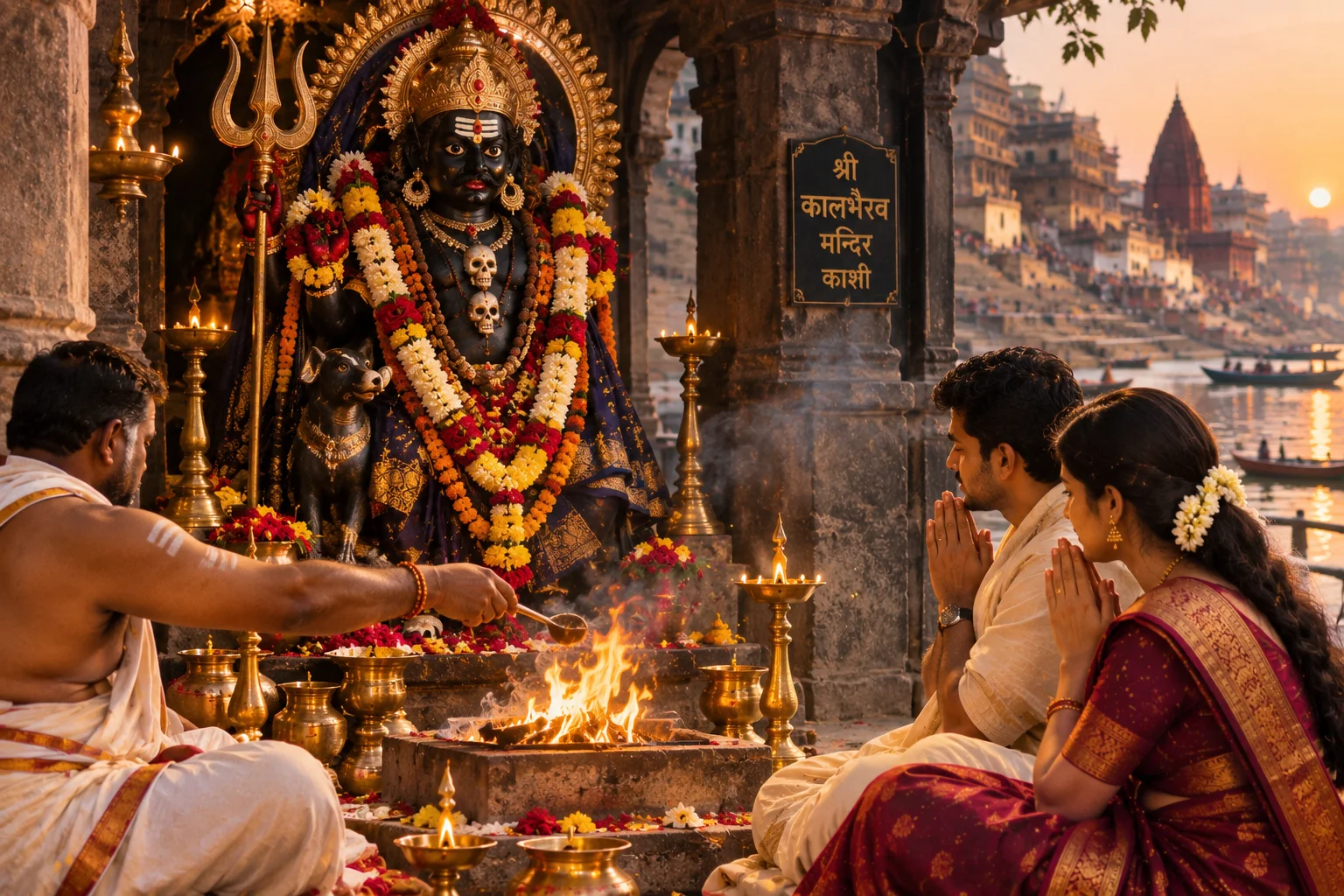
Sri Kalabhairava holds a special place in the spiritual traditions of Kashi. He is regarded as the Kshetrapal (guardian) of Varanasi, and according to Hindu belief, no one can enter Kashi without his permission. Devotees visiting the sacred city traditionally make it a point to visit the Kalabhairava Temple and seek his blessings. It is believed that a pilgrimage to Kashi remains incomplete without offering prayers to Sri Kalabhairava through Kalabhairava Samaradhana, a ritual involving his invocation and worship. To perform this sacred Puja according to traditional practices, the guidance of an experienced Pandit is important. TirthVaani helps devotees arrange Kalabhairava Samaradhana, Homam and various other religious ceremonies in Varanasi, making their spiritual journey more convenient.
In Shaivism, Kalabhairava is considered a fierce manifestation of Lord Shiva, associated with time, transformation and the destruction of evil. In Vajrayana Buddhism, he is also recognised as a powerful manifestation of Manjushri and is known by names such as Heruka, Vajrabhairava and Yamantaka. Although the historical origins of Bhairava remain uncertain, scholars have associated his worship with ancient regional and tribal traditions. Kalabhairava is worshipped across India, Nepal and Sri Lanka, as well as in Tibetan Buddhist traditions. He is regarded as the one who removes fear and protects devotees from negative influences. Performing Kalabhairava Homam in Varanasi is believed to help devotees overcome fear, enemies, greed, anger and other obstacles that prevent spiritual progress. Another traditional interpretation associates the syllables of Bhairava with creation, preservation and destruction, representing the three fundamental aspects of existence.
The origin of Kalabhairava is also described in a popular account from the Shiva Mahapurana, which narrates a conversation between Lord Brahma and Lord Vishnu. When Vishnu asked Brahma about the supreme creator of the universe, Brahma arrogantly declared himself to be the highest deity. Over time, his pride grew, and he began to consider himself equal to Lord Shiva. Witnessing this arrogance, Mahadeva manifested Kala Bhairava from his fingernail and instructed him to cut off one of Brahma's five heads. Kalabhairava carried Brahma's skull (Kapala), symbolising the destruction of ego and arrogance. This incident is associated with the spiritual significance of Kalabhairava as the remover of pride and ignorance. In many traditions, Bhairava is also regarded as the guardian of Shakti Peethas, with each sacred Shakti Peetha associated with a form of Bhairava.
Another traditional account describes how Lord Shiva manifested Bhairava through the combined divine energies of Goddess Parvati and Goddess Kali. According to this narrative, a demon named Dahurasura received a boon that he could only be defeated by a woman. Goddess Kali was invoked to destroy him, and after defeating the demon, her intense anger transformed into a child. Kali nurtured the child, and eventually, Lord Shiva merged both Kali and the child into his divine form. From this manifestation, the eight forms of Bhairava, known as Ashta Bhairavas, emerged. Since Bhairava manifested through Lord Shiva, he is also regarded in certain traditions as one of Shiva's divine sons. Devotees worship Kalabhairava to seek protection, overcome difficulties and receive his blessings. Performing Kalabhairava Samaradhana in Varanasi with the guidance of a knowledgeable Pandit is considered a meaningful way to express devotion and seek spiritual strength.
The Puranas also describe different accounts of the origin and manifestations of Bhairava. According to one such account, during a battle between the Devas and Asuras, Lord Shiva manifested Kala Bhairava to defeat the forces of evil. From him emerged the eight forms known as Ashta Bhairavas, who were associated with the Ashta Matrikas. These divine manifestations represent different aspects of Bhairava's protective and powerful nature. Devotees who wish to perform Kalabhairava Samaradhana in Varanasi can arrange the ceremony with the assistance of experienced Pandits through TirthVaani. We also help devotees organise various traditional religious ceremonies, including rituals at Gaya, Prayagraj, Pitru Karya in Varanasi and other sacred pilgrimage destinations.